What is an advanced network?
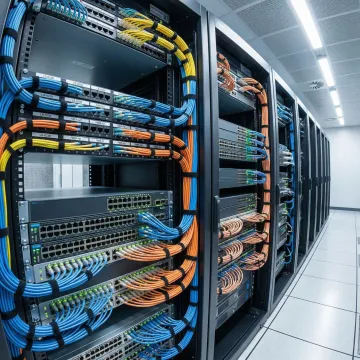
An advanced network is a sophisticated infrastructure that goes beyond basic connectivity to deliver high-performance, scalable, and secure communication capabilities. It typically includes structured cabling systems (Cat6, Cat6A, fiber optics), managed network hardware, integrated security systems, and centralized management platforms. Advanced networks are designed to support current business operations while accommodating future technology adoption, bandwidth growth, and multi-site expansion. They follow industry standards (BICSI, TIA, EIA, NEC) and incorporate best practices for reliability, security, and performance optimization.
What certifications should network installers have?
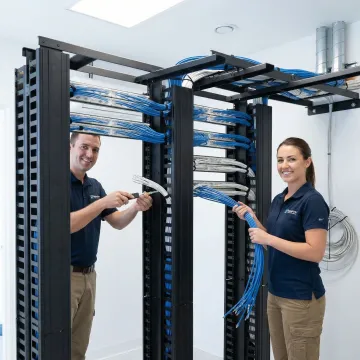
Professional network installers should hold certifications from recognized industry organizations including Panduit Certified Installer, BICSI (Building Industry Consulting Service International), and training in NEC (National Electrical Code), TIA (Telecommunications Industry Association), EIA (Electronic Industries Alliance), and FOA (Fiber Optic Association) standards. These certifications ensure installers understand proper cabling techniques, testing procedures, safety requirements, and compliance standards for commercial network infrastructure.
How long does a network infrastructure installation take?
Installation timelines vary based on project scope, facility size, and complexity. A small office with 20-30 network drops may take 3-5 business days, while enterprise deployments or multi-site installations can require several weeks. Data center infrastructure projects typically range from 1-3 weeks depending on rack density and cable management requirements. We provide detailed project timelines during the planning phase and work to minimize disruption to your business operations through phased implementations when appropriate.
What's the difference between Cat6 and fiber optic cabling?
Cat6 is copper-based cabling suitable for distances up to 100 meters, delivering speeds up to 10 Gbps. It's cost-effective for office workstations, IP phones, and local network connections. Fiber optic cabling uses light signals through glass fibers, supporting much longer distances (up to several kilometers) and higher bandwidth (40-100+ Gbps). Fiber is ideal for backbone connections, inter-building links, data center interconnects, and applications requiring immunity to electromagnetic interference. Most advanced networks use a combination of both technologies.
Do you support existing network infrastructure or only new installations?
We support both new installations and existing infrastructure. Our enterprise support services include troubleshooting, upgrades, expansions, hardware refreshes, and ongoing maintenance for networks installed by any vendor. We can audit your current infrastructure, identify improvement opportunities, and execute changes ranging from simple additions to complete network overhauls across single or multiple sites.
Can you integrate network infrastructure with security and AV systems?
Yes, integrated systems are a core specialty. We design unified infrastructure that supports IP-based security cameras, access control systems, VoIP communications, and professional audio-visual equipment—all operating on your structured network. This single-source approach eliminates technology silos, simplifies management, and creates a cohesive platform that's easier and more cost-effective to maintain than disparate systems from multiple vendors.
What testing and certification do you provide after installation?
Every installation includes comprehensive testing and certification using industry-standard equipment. For copper cabling, we perform continuity, wire mapping, length, attenuation, and crosstalk testing to TIA/EIA standards. Fiber optic installations receive OTDR testing, insertion loss measurements, and certification documentation. You receive detailed test reports documenting every cable run, verifying that your infrastructure meets or exceeds manufacturer specifications and industry standards for performance and reliability.
How do you minimize business disruption during network installations?
We offer flexible scheduling including after-hours and weekend installations to minimize impact on daily operations. Our project management approach includes phased implementations, temporary connectivity solutions, and detailed coordination with your IT team. For occupied facilities, we prioritize noise-sensitive work during off-hours, maintain clean work areas, and provide clear communication about project progress and any required network downtime.