What types of network cabling do you install?
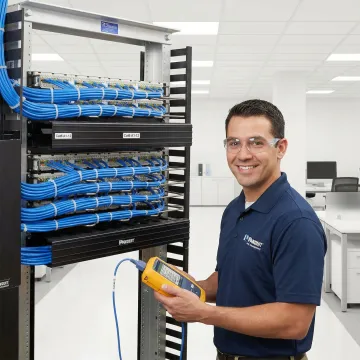
We install a full range of structured cabling solutions including Cat5e, Cat6, and Cat6A copper cabling for voice and data, as well as single-mode and multimode fiber optic cabling (OM1, OM2, OM3, OM4). All installations are performed by Panduit-certified installers following BICSI, NEC, TIA, and EIA standards with complete testing and certification.
Do you provide network cabling certification and testing?
Yes, we provide comprehensive certification testing for all copper and fiber installations using Fluke-certified testing equipment. Our testing validates performance, ensures compliance with manufacturer specifications and industry standards, and provides documented assurance for long-term network reliability.
Can you handle large-scale or multi-site network cabling projects?
Absolutely. We support national contractors, MSPs, and organizations with single-site or multi-site infrastructure deployments across Florida and Georgia. Our team has extensive experience staging, managing, and implementing complete networking solutions for enterprises, campuses, and institutional environments.
What is structured cabling and why is it important?
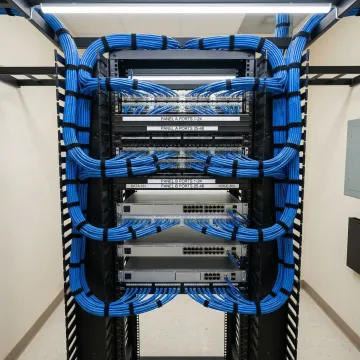
Structured cabling is an organized, standards-compliant framework that supports all your voice, data, and network connectivity. It improves network performance, simplifies maintenance and troubleshooting, enables future technology upgrades without disruption, and eliminates cable sprawl. A properly structured system is essential for reliable, scalable operations.
Do you work with specific manufacturers or brands?
We install industry-leading components from trusted manufacturers including Panduit, CommScope, Corning, Leviton, Chatsworth, Legrand, APC, Eaton, and Vertiv. Our technicians are certified and trained on these systems to ensure proper installation and maximum performance.
Can you support our data center cabling needs?
Yes, we specialize in data center structured cabling including rack layout planning, fiber backbone installation, copper interconnects, power distribution support, and complete cable management systems. Our installations optimize airflow, simplify maintenance, and minimize downtime risk in critical IT environments.
What does the network cabling installation process involve?
Our process begins with site assessment and design, followed by professional installation of cable pathways, terminations, and patch systems. We then perform comprehensive testing and certification, complete detailed labeling and documentation, and provide final walkthrough and training. Every step follows strict industry standards.
How long does a typical network cabling project take?
Project timelines vary based on scope, size, and complexity. A small office installation might take a few days, while large campus or multi-floor deployments can take several weeks. We provide detailed timelines during the planning phase and work efficiently to minimize disruption to your operations.