Introduction
You're opening a third location next quarter, onboarding 50 remote employees, and migrating critical applications to the cloud. Your network can barely handle today's load, let alone tomorrow's expansion. What worked for 30 employees in one office now buckles under the demands of distributed operations and data-intensive workflows. According to recent industry data, network-related issues account for 31% of all IT service outages, directly impacting revenue and customer satisfaction.
This bottleneck isn't just an IT inconvenience—it directly determines whether you can scale operations, add locations, and maintain performance across distributed teams.
When infrastructure can't keep pace, the consequences are immediate: slow application performance, security vulnerabilities, and month-long delays when opening new sites. Your network foundation either supports your growth ambitions or becomes the obstacle preventing them.
TLDR:
- Network downtime costs mid-sized businesses over $300,000 per hour on average
- Properly designed infrastructure cuts new site deployment time from 12 weeks to 3
- Fragmented systems create security gaps and drive up operational costs
- Your infrastructure must handle cloud applications, remote teams, IoT devices, and video collaboration simultaneously
- Certified installation eliminates 85% of performance issues caused by improper termination and testing
Why Network Infrastructure is Critical for Business Growth
Network infrastructure serves as the foundation for all digital business operations, from basic communications to mission-critical cloud applications. When this foundation is solid, businesses can pursue growth opportunities confidently. When it's weak, every expansion effort becomes a struggle.
The Financial Impact of Network Downtime
Large enterprises face downtime costs between $500,000 and $5 million per hour, with high-stakes sectors like finance and healthcare at the upper end of that range. For mid-market companies, the impact is equally severe—over 90% report that a single hour of downtime costs more than $300,000.
Beyond immediate revenue loss, network outages damage customer relationships and brand reputation. Research shows that 60% of enterprises experience customer attrition following an outage, and it can take up to 60 days for brand health to recover.
These cascading effects make network reliability a business continuity imperative, not just an IT concern.
Modern Business Demands on Network Infrastructure
Today's business requirements place increasing demands on network infrastructure:
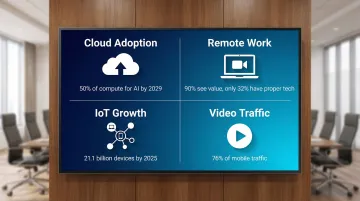
- Cloud adoption has shifted critical applications off-premises, requiring consistent, high-bandwidth connections to maintain performance. By 2029, 50% of cloud compute resources are predicted to be devoted to AI workloads, up from less than 10% today.
- Remote and hybrid work models depend on reliable connectivity for video conferencing, VoIP, and collaboration platforms. While 90% of employees see value in collaboration tools, only 32% of employers are investing in the high-grade technology required to support them effectively.
- IoT proliferation continues accelerating, with connected devices reaching 21.1 billion by the end of 2025. Each device adds to network traffic and requires proper segmentation and security.
- Video collaboration has become standard practice, with video traffic projected to account for 76% of all mobile traffic. High-quality video conferencing requires dedicated bandwidth and low latency that legacy infrastructure often cannot deliver.
How Infrastructure Enables or Constrains Strategic Initiatives
Network infrastructure directly determines whether strategic business initiatives succeed or stall. Consider these real-world examples:
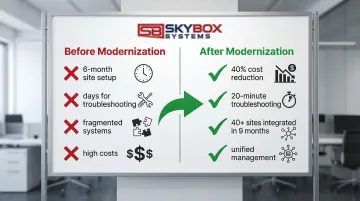
Vulcan, a manufacturing and distribution company, faced site setup times of up to six months due to aging infrastructure and fragmented systems. Simple troubleshooting often took days.
After modernizing to a cloud-managed network, they reduced networking costs by 40%, cut troubleshooting time to 20 minutes, and integrated over 40 acquired sites in just nine months.
Similarly, Samsøe Samsøe, a retailer expanding internationally, found their on-premises servers and patchwork wired connections hindered growth.
Transitioning to wireless-first infrastructure allowed them to deploy network updates across all stores in under an hour, dramatically accelerating their expansion timeline.
These examples illustrate a fundamental truth: your network infrastructure either accelerates growth or creates friction at every step. Mergers and acquisitions, new branch openings, and digital transformation initiatives all depend on infrastructure that can scale quickly without requiring complete replacement.
Common Network Infrastructure Challenges That Limit Growth
Growing businesses typically encounter several infrastructure obstacles that constrain their ability to scale efficiently and securely.
Fragmented and Siloed Systems
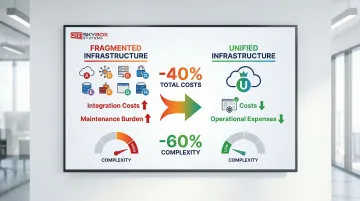
Businesses often accumulate disconnected networking technologies over time, creating complexity that becomes increasingly difficult to manage. Each acquisition, location addition, or technology refresh may introduce new vendors and platforms that don't integrate seamlessly.
This fragmentation creates operational friction. When an outage occurs, IT teams struggle to determine whether the issue stems from connectivity, routing, configuration, or hardware failure.
68% of technology leaders now plan to consolidate their vendor landscape, with many targeting a 20% reduction in vendor count specifically to reduce this complexity.
Insufficient Bandwidth and Capacity
Legacy infrastructure wasn't designed for today's data-intensive applications and cloud services. Device proliferation compounds the problem—the average number of connected devices per business location doubled between 2020 and 2025 and is expected to grow another 80% by 2030.
Modern applications demand significant bandwidth:
- High-quality video conferencing requires 4 Mbps per endpoint for 1080p resolution
- 8K video streams consume up to 300 Mbps
- Extended Reality (XR) applications can require speeds of 1,000 Mbps with latency under 3ms
When infrastructure can't deliver this capacity, application performance suffers, productivity declines, and customer experience deteriorates.
Lack of Scalability
Traditional hardware-based networking approaches require lengthy procurement cycles and significant capital investment to expand. Adding a new location might mean waiting weeks or months for equipment, scheduling installation, and configuring systems manually.
The impact on growth is direct:
- Businesses can't respond quickly to market opportunities
- Expansion projects that should take weeks stretch into months
- Infrastructure limitations become the bottleneck preventing business growth
When your network can't scale at the pace your business demands, opportunities slip away to more agile competitors.
Security Vulnerabilities
As networks grow organically without unified planning, security gaps emerge between systems and locations. Misconfiguration—a top-three error in data breaches—becomes more likely as complexity increases. Even major technology companies are vulnerable; a misconfiguration in 2020 exposed 250 million customer support records.
Flat networks without proper segmentation allow attackers to move laterally once they gain initial access. Without unified security policies across all locations and systems, businesses face increasing risk as they grow.
High Operational Costs
Maintaining multiple vendors, technologies, and point solutions drives up both capital and operational expenses. Integration costs escalate when trying to connect systems not designed to work together.
Managing hundreds of disparate tools becomes exponentially expensive, with issues in one system potentially cascading across multiple services. These operational costs often exceed the initial capital investment, making fragmented infrastructure increasingly expensive over time.
Essential Components of Growth-Ready Network Infrastructure
Scalable network infrastructure requires several foundational components working together as an integrated system.
Structured Cabling and Fiber Infrastructure
High-quality structured cabling forms the physical foundation that must support current and future bandwidth requirements.
Unlike equipment that can be upgraded, cabling infrastructure typically remains in place for 10-15 years or longer. Poor installation choices create expensive problems that can't be easily fixed later.
Professional installation following BICSI, TIA, and EIA standards prevents the performance degradation and intermittent issues that plague poorly installed systems. Standards-compliant installation ensures reliability and performance over the infrastructure's lifespan.
Fiber optic cabling provides significant advantages for high-bandwidth, low-latency connections between locations and to cloud services. Fiber supports substantially higher bandwidth than copper cabling, experiences minimal signal degradation over distance, and provides immunity to electromagnetic interference.
Skybox Systems serves as a Panduit Certified Installer with BICSI, NEC, FOA, EIA, and TIA standards-trained technicians. Our team provides professional structured cabling installation that meets manufacturer specifications and local building codes.
This certification ensures installations are performed correctly the first time, protecting your investment and providing the foundation for reliable network performance.
High-Capacity Network Equipment
Enterprise-grade switches, routers, and network appliances handle growing traffic volumes while providing the features necessary for security, quality of service, and management.
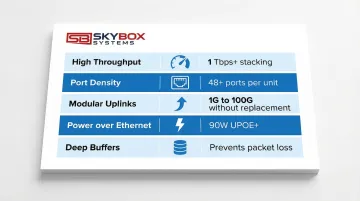
Key specifications for growth-ready equipment:
| Feature | Why It Matters |
|---|---|
| High throughput | Supports current traffic loads with headroom for growth (1 Tbps+ stacking bandwidth) |
| Port density | Accommodates device growth without requiring additional switches (up to 48+ ports per unit) |
| Modular uplinks | Allows bandwidth upgrades from 1G to 100G without chassis replacement |
| Power over Ethernet | Supports high-power devices like access points and cameras (90W UPOE+) |
| Deep buffers | Prevents packet loss during traffic bursts from video and multimedia |
Equipment selection should prioritize platforms that support future expansion without requiring complete replacement. Modular designs with software-defined capabilities extend useful life and protect capital investment.
Reliable Internet Connectivity
Business continuity depends on internet connectivity that doesn't fail. Over 70% of network outages originate in the physical connectivity layer, making redundancy essential.
Connectivity options for reliability:
- Dedicated fiber internet provides high speed, large bandwidth, and superior reliability compared to shared connections, often backed by 100% uptime guarantees
- SD-WAN creates a virtual overlay that combines multiple connection types (MPLS, broadband, LTE) with automatic failover, ensuring high uptime
- Backup circuits from secondary ISPs or cellular connections prevent single points of failure
These strategies work best when layered together. Effective redundancy combines multiple internet connections, redundant network paths, and backup power systems to ensure operations continue even when individual components fail.
Integrated Security Infrastructure
Network architecture should incorporate security from the initial design phase. Integrated security from a single provider reduces complexity and closes the gaps that emerge when managing separate security tools.
Network segmentation divides the network into distinct security zones, limiting the attack surface and containing breaches. This microsegmentation approach ensures that a compromise in one segment (such as a user device) doesn't grant access to critical assets like database servers.
Unified security policies across firewalls, access control, and monitoring systems provide consistent protection as the business grows. When security components work together as an integrated system, IT teams gain visibility across the entire infrastructure and can respond to threats more effectively.
Cloud services and remote work have changed security requirements. Modern networks need granular access controls and segmentation that follow Zero Trust Architecture principles.
Unified Communication Systems
Modern businesses require robust audio-visual and collaboration infrastructure to support distributed teams. These systems place specific demands on network infrastructure.
Network requirements for communication systems:
| Application | Bandwidth Required | Performance Threshold |
|---|---|---|
| VoIP calls | ~100 kbps per line | Jitter <30ms, latency <300ms, packet loss <1% |
| HD video calls | 8 Mbps | Latency <20ms |
| Microsoft Teams (1080p) | 4 Mbps up/down | Optimized for high-motion content |
| 4K video streaming | 50 Mbps | Latency <50ms |
Even minor packet loss (2%) can cause frozen frames and blurry images in video calls. Network infrastructure must provide consistent, low-latency performance to support the collaboration tools that modern work depends on.
Benefits of Scalable Network Infrastructure Solutions
Growing businesses face a constant challenge: infrastructure that can't keep pace with expansion plans. Scalable network infrastructure solves this by delivering measurable returns through faster deployment, improved efficiency, and cost optimization.
Faster Time-to-Market for New Initiatives
Scalable infrastructure reduces deployment timelines significantly, enabling faster business expansion. Modern data center networking solutions can reduce provisioning time from 8-12 hours to just 30 minutes, enabling up to 85% faster deployment.
For businesses opening new locations, the difference is even more striking. Traditional approaches requiring on-site equipment installation and manual configuration can take months. With professional installation of cloud-managed, scalable infrastructure, new sites can be deployed in days or weeks, not months.
This speed advantage translates directly to competitive advantage. Businesses can respond to market opportunities, complete acquisitions faster, and launch new services without waiting for infrastructure projects to complete.
Improved Operational Efficiency
Unified management reduces complexity and allows IT teams to focus on strategic priorities rather than troubleshooting. Centralized visibility across all locations and systems cuts troubleshooting time from days to minutes in some cases.
Key productivity improvements include:
- 80% reduction in infrastructure build time through centralized management
- 132% increase in time available for innovation and strategic business projects
- Faster problem resolution with unified visibility across all locations
- Reduced complexity allowing teams to shift focus from routine maintenance to value-driving initiatives
This operational efficiency becomes particularly valuable as organizations scale across multiple sites.

Cost Predictability and Optimization
Right-sized infrastructure with clear upgrade paths helps control capital and operational expenses while avoiding over-provisioning. Organizations using scalable infrastructure platforms achieved a 192% ROI with payback periods under six months.
Modern infrastructure can drive up to 90% lower operating expenses through automation and efficiency.
Rather than large, periodic capital investments for complete infrastructure replacement, scalable solutions enable incremental upgrades that spread costs over time and align spending with business growth.
Scalable solutions also help avoid costly over-provisioning. Instead of purchasing capacity for projected peak demand years in the future, businesses can start with what they need today and expand as requirements grow.
Planning Your Network Infrastructure for Growth
Strategic planning ensures infrastructure investments support both immediate needs and long-term growth objectives.
Conduct a Comprehensive Assessment
Before planning upgrades, conduct a thorough assessment of current infrastructure to identify bottlenecks, security gaps, and capacity limitations. This assessment should examine:
- Current bandwidth utilization and capacity headroom
- Equipment age and end-of-life timelines
- Security architecture and vulnerability exposure
- Management complexity and operational overhead
- Performance metrics for critical applications
Understanding where current infrastructure falls short provides the foundation for prioritizing improvements that deliver the greatest business impact.
Develop a Phased Implementation Approach
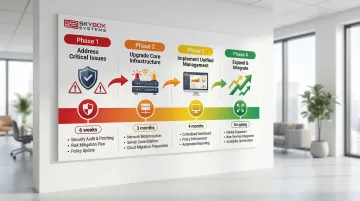
Address immediate needs while building toward long-term scalability goals through phased implementation. This approach minimizes disruption, spreads costs over time, and allows for adjustments based on changing business requirements.
A typical phased approach might:
- Phase 1: Address critical bottlenecks and security vulnerabilities that pose immediate risk
- Phase 2: Upgrade core infrastructure components (switching, routing, connectivity) to provide scalability foundation
- Phase 3: Implement unified management and monitoring for operational efficiency
- Phase 4: Expand to additional locations and integrate advanced capabilities
Phased implementation reduces risk compared to "big bang" replacements and ensures business operations continue without interruption.
Partner with Experienced Infrastructure Providers
Work with experienced infrastructure providers who can design integrated solutions and provide ongoing support as your business grows. Managing multiple vendors for network infrastructure, security, and communication systems creates coordination challenges and potential security gaps.
A single-source approach solves this problem. Providers who deliver structured cabling, network equipment, security systems, and communication platforms as unified solutions streamline deployment and ongoing management.
Professional installation matters just as much as the design. Certified technicians implement infrastructure correctly from the start, protecting your investment and providing the reliability growing businesses require.
Look for providers whose technicians maintain certifications in industry standards:
- Infrastructure standards: BICSI, NEC, FOA, EIA, TIA
- Manufacturer credentials: Panduit Certified Installer and similar certifications
- Integration expertise: Experience coordinating multiple system types
Skybox Systems' installation teams maintain these certifications, ensuring each deployment meets both manufacturer specifications and industry best practices. This approach delivers infrastructure components optimized to work together as an integrated ecosystem rather than disconnected silos.
Frequently Asked Questions
Which type of network is best for a company operating across multiple city locations (MAN, LAN, WLAN, PAN)?
For multi-city operations, a Wide Area Network (WAN) is the right choice. Each location maintains its Local Area Network (LAN), connected via SD-WAN, MPLS, or dedicated fiber. SD-WAN typically offers the best balance of cost, performance, and flexibility.
What network infrastructure is needed to support business growth?
Growth-ready infrastructure requires structured cabling to industry standards (BICSI, TIA/EIA), high-capacity equipment with modular upgrade paths, redundant connectivity, and integrated security. Professional installation by certified technicians ensures these components work together reliably as your business expands.
How do I know if my current network can scale with my business?
Watch for frequent performance issues, difficulty adding new locations quickly, and bandwidth utilization exceeding 70-80% on critical links. If expansion requires significant capital investment or your IT team spends most time on maintenance rather than strategic projects, your infrastructure can't scale effectively.
What's the difference between network scalability and network capacity?
Capacity is how much traffic your network handles now (such as a 10 Gbps link). Scalability is how easily it grows to meet future needs through modular upgrades rather than complete replacement.
How much should I budget for scalable network infrastructure?
Budget depends on your business size and requirements, but consider total cost of ownership—installation, equipment, management, and future expansion. Scalable solutions have higher initial costs but lower total cost over time compared to repeated replacements. A professional assessment helps right-size the investment.
What are the signs my network infrastructure is limiting business growth?
Warning signs include slow application performance, lengthy timelines for opening new locations, frequent downtime, and IT teams focused on maintenance rather than strategic projects. If expansion opportunities are delayed due to infrastructure constraints, your network is limiting growth.