Introduction
Remote teams, cloud-based operations, and sophisticated cyber threats have transformed how small businesses approach networking infrastructure. What worked in 2020 won't protect your data or support your growth in 2026.
The stakes are measurable. 88% of SMB breaches now involve ransomware, while cloud spending has reached $723.4 billion globally. The right networking solutions provider delivers more than equipment—they design integrated systems, handle professional installation, provide ongoing support, and build infrastructure that scales with your business.
This guide profiles top providers helping small businesses build secure, scalable networks in 2026.
Key Takeaways
- Small business networking includes infrastructure, security, and management services
- Top providers deliver scalable systems with certified installation and integrated security
- Choose based on certifications, technology partnerships, service scope, and TCO
- Options span cloud-managed platforms to full-service integrators for different budgets
Overview of Networking Solutions in the Small Business Market
Small businesses today struggle with complex connectivity demands—remote workers, cloud applications, cybersecurity threats, and customer-facing systems all competing for reliable network performance. Networking solutions address these challenges by combining physical infrastructure (cabling, switches, routers, wireless access points), network management software, security systems, and professional services into a cohesive digital backbone.
The small business networking market reflects this growing complexity. The SMB switch market reached $2.36 billion in 2025 and is projected to grow at 7.48% annually through 2032, driven by cloud adoption and hybrid work models.
This growth represents a fundamental shift: small businesses now view networking as strategic infrastructure that directly impacts security, productivity, and competitive advantage—not just a commodity IT purchase.

The providers below represent different approaches to small business networking—from cloud-managed simplicity to comprehensive infrastructure integration. We selected them based on reliability, scalability, and proven small business expertise.
Top Networking Solutions Providers for Small Businesses in 2026
The following providers stand out for their small business focus, combining technology innovation with service quality, industry certifications, and strong customer satisfaction.
Cisco Systems (Cisco Business/SMB Solutions)
Cisco's global networking leadership extends to small businesses through their Cisco Business division, which delivers enterprise-grade technology at accessible price points specifically designed for SMB environments.
What sets them apart:
- Extensive product portfolio from 250 Series Smart Switches to 350 Series Managed Switches
- Simplified management through Cisco Business Dashboard
- Strong partner ecosystem for local support and industry-leading warranties
- 250 Series supports embedded monitoring without separate management hardware
- 350 Series provides Layer 3 static routing for complex network architectures
| Key Strengths | Best For | Considerations |
|---|---|---|
| Enterprise-grade reliability, comprehensive product range, extensive partner network, strong security integration | Growing businesses needing scalable, future-proof infrastructure with robust security | Higher initial investment, may require professional installation and ongoing management |
Ubiquiti Networks (UniFi)
Ubiquiti's UniFi platform revolutionized small business networking by delivering enterprise features at prosumer prices, particularly popular among tech-savvy small businesses and managed service providers.
Key differentiators:
- Cloud-managed unified platform with exceptional price-to-performance ratio
- Single-pane-of-glass management through the UniFi Controller
- No licensing fees—software bundled with hardware
- Active user community with frequent feature updates
- UniFi Cloud Gateways, switches, and access points work seamlessly with device discovery across multiple locations
| Key Strengths | Best For | Considerations |
|---|---|---|
| Cost-effective, intuitive management interface, strong WiFi performance, scalable architecture | Budget-conscious businesses with some technical capability or working with MSPs | Limited enterprise support options, requires technical knowledge for advanced configurations |
SonicWall
SonicWall specializes in security-first networking solutions, offering integrated firewall, VPN, and threat protection specifically designed for small and medium businesses facing sophisticated cyber threats.
What distinguishes them:
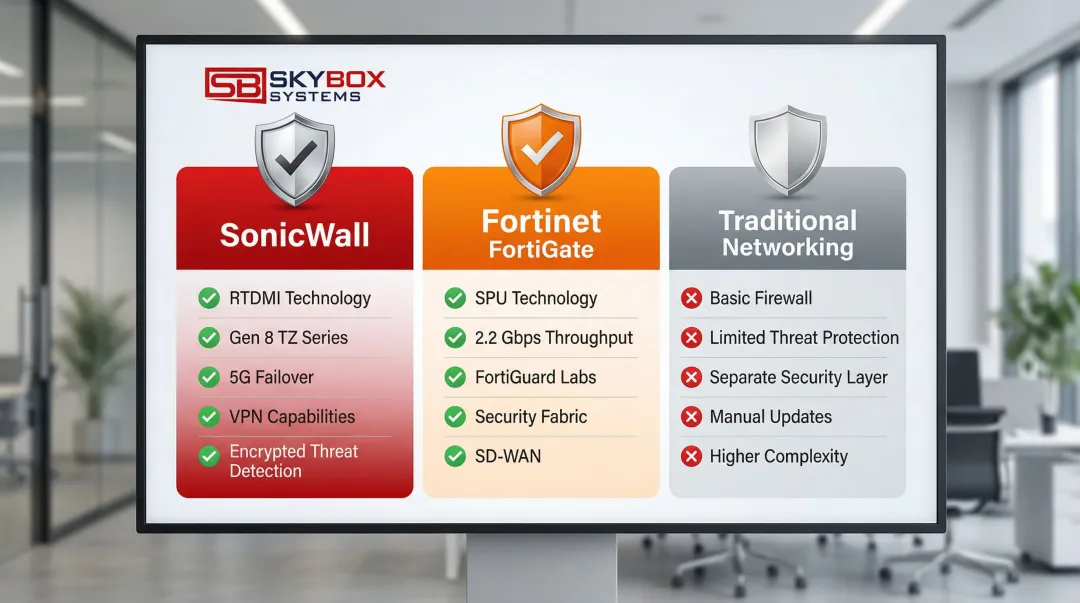
- Real-Time Deep Memory Inspection (RTDMI) detects encrypted attacks
- Gen 8 TZ Series firewalls support high-speed SFP+ ports (up to 10Gbps), 5G/LTE failover
- Comprehensive VPN capabilities for remote workers with zero-touch deployment
- Unified threat management with proven track record protecting distributed environments
| Key Strengths | Best For | Considerations |
|---|---|---|
| Integrated security and networking, strong VPN performance, real-time threat protection, SMB-focused pricing | Businesses prioritizing security, remote workforce support, and regulatory compliance | Subscription-based security services add to total cost, requires proper configuration for optimal protection |
Aruba Networks (HPE)
Aruba's cloud-native networking approach brings AI-driven network intelligence and simplified management to small business environments through their Aruba Instant On and Aruba Central platforms.
Their differentiation:
- AI-powered optimization automatically detects and resolves network issues
- Cloud-managed infrastructure eliminates on-site controllers, reducing costs
- Excellent mobile app for network management from anywhere
- Strong WiFi 6/6E performance with HPE enterprise-grade reliability
- Industry-leading limited lifetime warranty for switches
| Key Strengths | Best For | Considerations |
|---|---|---|
| AI-driven network optimization, cloud-native management, no controller hardware needed, excellent WiFi performance | Businesses seeking modern, self-optimizing networks with minimal IT overhead | Subscription costs for advanced features, newer platform with smaller partner ecosystem than Cisco |
Skybox Systems
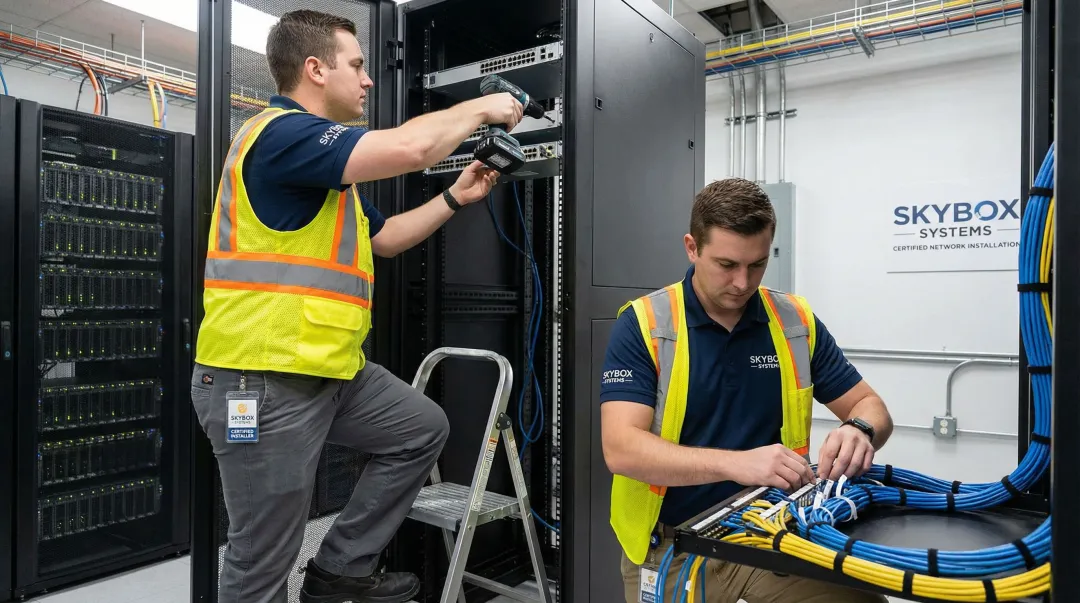
Skybox Systems has served Florida and Georgia as a strategic infrastructure partner since 2009, providing integrated networking, cabling, security, and audio/visual solutions for small and mid-sized businesses.
Their differentiation:
- Comprehensive infrastructure approach combining structured cabling, fiber optics, network installation, and security systems
- Panduit Certified Installers with BICSI, NEC, FOA, EIA, and TIA standards training
- Single-source accountability from design through ongoing support
- Authorized Dell and SonicWall partner
- Future-proof installations using high-quality components for maximum bandwidth and minimal downtime
| Key Strengths | Best For | Considerations |
|---|---|---|
| Certified installation expertise, integrated infrastructure approach, single-source accountability, future-proof design, regional presence in FL/GA | Businesses needing complete infrastructure solutions with professional installation, structured cabling, and ongoing regional support | Service area limited to Florida and Georgia, full-service approach may exceed needs of businesses only requiring basic equipment |
Cisco Meraki
Meraki's cloud-first networking platform (owned by Cisco) introduced simplified, centralized management that allows small businesses to deploy and manage networks without extensive technical expertise.
What sets them apart:
- 100% cloud-managed architecture eliminates on-site controllers entirely
- "Zero-touch" provisioning—devices automatically connect to cloud dashboard
- Powerful analytics provide deep insights into network performance and user behavior
- Automatic firmware updates ensure security patches deploy without manual intervention
- Strong integration across switching, wireless, security, and SD-WAN
| Key Strengths | Best For | Considerations |
|---|---|---|
| Simplest deployment and management, powerful cloud dashboard, automatic updates, excellent visibility and reporting | Multi-location businesses or those without dedicated IT staff needing simple, reliable management | Requires ongoing licensing subscription, higher total cost of ownership, internet dependency for management |
Fortinet (FortiGate)
Fortinet's security-driven networking approach delivers integrated networking and security through their FortiGate platform, specifically designed for small business threat protection without complexity.
Their differentiation:
- Security Processing Unit (SPU) technology delivers high threat protection throughput (up to 2.2 Gbps for 90G model)
- FortiGuard Labs provides real-time protection against emerging threats
- Excellent price-performance ratio for integrated security and SD-WAN capabilities
- Simplified management through FortiCloud
- Security Fabric integrates switch and access point management directly into firewall
| Key Strengths | Best For | Considerations |
|---|---|---|
| Security-integrated networking, strong threat protection, competitive pricing, SD-WAN capabilities, unified management | Security-conscious businesses needing integrated firewall, VPN, and network management in single platform | Security focus means networking features may be less advanced than pure networking vendors, subscription required for security services |
How We Chose the Best Networking Solutions Providers
Small businesses often make the mistake of choosing networking solutions based solely on upfront cost or brand recognition.
The right criteria should balance initial investment, total cost of ownership, scalability, support quality, and alignment with specific business needs and growth plans.
We evaluated providers based on:
- Industry certifications and standards compliance - BICSI, TIA, vendor certifications that ensure quality installation
- Technology partnerships - Authorized status with major vendors indicating technical competency
- Service breadth - From installation through ongoing support, not just equipment sales
- Proven small business customer base - Case studies and experience with similar organizations
- Scalability - Solutions that grow from 5 to 50+ employees without complete replacement
- Integration capabilities - Unified networking and security rather than siloed systems
- Local/regional support availability - Response times and on-site service when needed
These criteria matter differently depending on your situation.
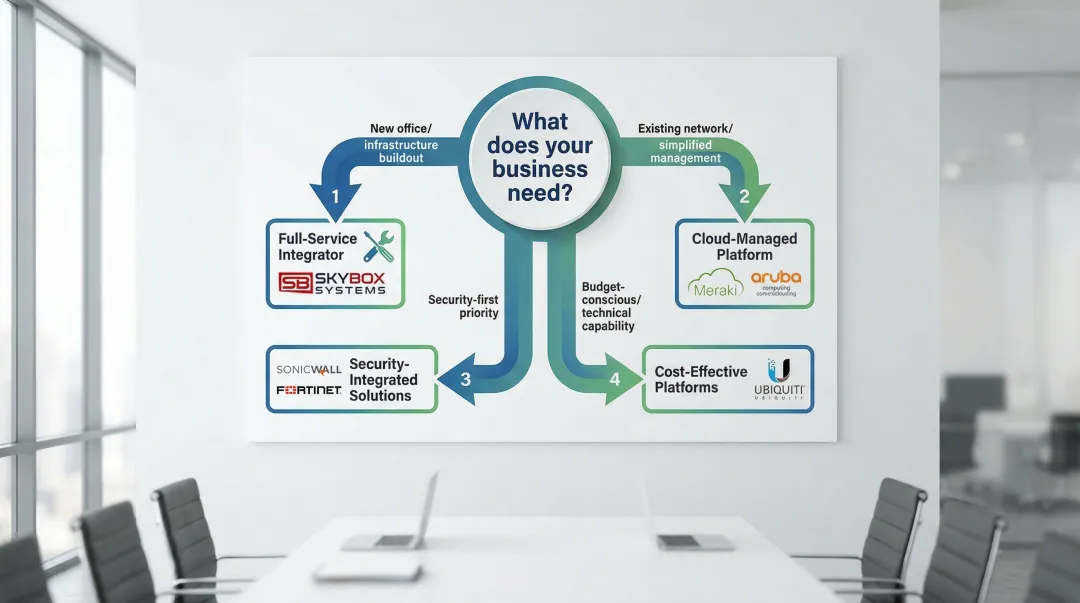
Businesses needing complete infrastructure build-outs should consider full-service integrators with certified installation teams like Skybox Systems. Those with existing infrastructure may prefer cloud-managed platforms like Meraki or Aruba Instant On for simplified ongoing management.
Match provider strengths to your specific requirements and technical capabilities.
Conclusion
Selecting a networking solutions provider means finding a strategic partner who understands small business constraints and growth trajectories.
The right provider combines quality products, certified installation expertise, integrated security solutions, and infrastructure support that scales with your business.
Evaluate providers based on your specific needs: businesses building new offices or undergoing infrastructure overhauls should prioritize certified installation expertise and comprehensive service offerings, while those with existing networks might focus on cloud-managed platforms for simplified ongoing management. Consider both immediate connectivity requirements and 3-5 year business growth plans when making your decision.
Skybox Systems provides integrated networking and infrastructure solutions for small and mid-sized businesses across Florida and Georgia, combining Panduit-certified installation expertise with comprehensive installation and infrastructure services from BICSI, NEC, FOA, EIA, and TIA trained technicians. Contact us at 904-586-4027 or info@skyboxsystems.com to discuss how our comprehensive approach to structured cabling, networking, and security can support your business growth.
Frequently Asked Questions
What is the best network topology for a small office?
Star topology is most practical for small offices, where each device connects to a central switch or router for easy troubleshooting and scalability. Mesh topology works well for wireless networks in hard-to-wire areas.
What's the difference between cloud-managed and traditional networking equipment?
Cloud-managed networking uses internet-based dashboards for remote configuration and monitoring without on-site controllers. Traditional networking requires on-site or VPN access for changes, with no recurring cloud fees but less flexibility.
How much should a small business budget for networking infrastructure?
Small businesses typically invest $5,000-$25,000 for quality infrastructure including switches, access points, firewall, cabling, and professional installation. Proper initial investment prevents costly problems and frequent replacements.
Do I need professional installation or can I set up business networking myself?
Professional installation by certified technicians ensures proper cabling, equipment placement, security configuration, and standards compliance. Improper DIY installation often leads to performance issues and expensive remediation that costs more than professional installation upfront.
What networking certifications should I look for in an installation company?
Look for BICSI certification for structured cabling, manufacturer certifications like Panduit or CommScope, TIA/EIA standards training, and vendor-specific certifications. These certifications ensure installers follow industry best practices and can properly warranty their work.
How often should small business networking equipment be upgraded?
Networking equipment typically has a 5-7 year lifecycle, though security appliances and wireless access points may need replacement every 3-5 years. Plan refreshes based on warranty expiration and security support end-of-life rather than waiting for failures.