What is a typical cost of network cable installation?
Network cable installation costs vary based on several factors including the scope of your project, cable type (Cat6, Cat6A, or fiber optic), building layout, distance, number of drops, and whether new pathways or telecom closets are needed. A typical office installation might range from $100-$300 per drop for basic Cat6 cabling, while fiber optic installations or complex structured cabling projects with multiple telecommunications rooms will cost more. We provide detailed free assessments and transparent quotes that account for your specific Jacksonville building requirements, desired cable types, testing and certification needs, and future scalability. Our pricing includes professional installation by certified technicians, proper labeling and documentation, and performance testing to ensure your investment delivers reliable connectivity.
Who do I call to run an Ethernet cable through my house?
For residential Ethernet cable installation in Jacksonville, contact a licensed low-voltage contractor or telecommunications specialist like Skybox Systems. While we primarily serve commercial clients, offices, and institutions, we can recommend qualified residential installers or discuss whether your home office or small business needs align with our commercial services. Professional installation ensures cables are run safely through walls, meet code requirements, are properly terminated, and deliver the performance you expect. Avoid unlicensed handyman services for network cabling—improper installation can lead to poor connectivity, safety issues, and code violations that are costly to correct.
How long does a typical network cabling installation take?
Installation timelines depend on project size and complexity. A small office with 10-20 network drops might take 1-2 days, while a complete structured cabling system for a multi-floor building or campus could require several weeks. We provide realistic timelines during our initial assessment, coordinate with your construction schedule or business operations, and work efficiently to minimize disruption. Our experienced Jacksonville team handles everything from cable routing and termination through testing and certification to ensure your network is operational on schedule.
What's the difference between Cat6 and Cat6A cabling?
Cat6 cabling supports speeds up to 10 Gbps for distances up to 55 meters and is suitable for most general office applications. Cat6A (augmented) supports 10 Gbps for the full 100-meter channel length and offers superior shielding against crosstalk and interference, making it ideal for high-density environments, data centers, or installations requiring maximum future-proofing. While Cat6A costs more upfront, it provides better long-term value for bandwidth-intensive applications and eliminates the need for costly upgrades as network demands increase. We'll recommend the appropriate cable grade based on your current needs and growth plans.
Do you handle fiber optic cable installation and splicing?
Yes, our FOA-trained technicians specialize in fiber optic installation, termination, fusion splicing, and certification for both single-mode and multimode fiber systems (OM1, OM2, OM3, OM4). We use premium Corning, Panduit, CommScope, and AFL components to ensure optimal signal integrity for backbone connections, data center interconnects, campus networks, and carrier handoffs. Every fiber installation includes comprehensive testing and certification documentation to verify performance and compliance with industry standards.
Will my existing network infrastructure need to be replaced?
Not necessarily. During our initial site assessment, we evaluate your current cabling infrastructure, test performance, review documentation, and identify whether existing cables can be reused, need upgrading, or should be replaced. Many businesses can integrate new cabling with existing infrastructure, though older Cat5 or improperly installed cables may limit performance and should be upgraded to support modern network speeds and reliability. We provide honest recommendations based on your actual needs and budget rather than pushing unnecessary replacements.
Are your technicians certified and insured?
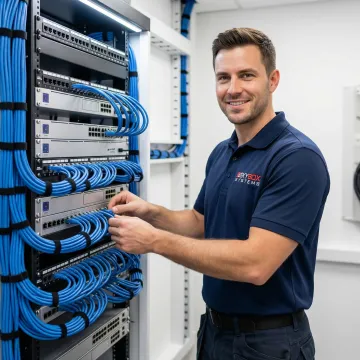
Yes, all Skybox Systems technicians are Panduit-certified installers and trained to BICSI, NEC, FOA, EIA, and TIA industry standards. We maintain full liability insurance and workers' compensation coverage, and our work complies with Florida building codes and Jacksonville commercial requirements. Our certifications and training ensure proper installation practices, code compliance, and optimal system performance backed by manufacturer warranties and our commitment to quality workmanship.
Do you provide documentation and labeling for installed cables?
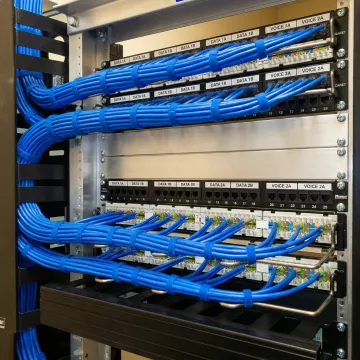
Absolutely. Comprehensive documentation and labeling are essential components of every Skybox Systems installation. We provide detailed as-built drawings, cable schedules, jack labels, patch panel documentation, and test reports for every drop and cable pathway. Proper documentation simplifies future moves, adds, changes, troubleshooting, and maintenance while ensuring anyone managing your network can quickly understand the infrastructure. Our structured approach saves time and money over the life of your installation.