Introduction
Network downtime costs businesses an average of $5,600 per minute, making reliable cable testing critical for preventing costly outages. Infrastructure projects demand testing equipment that meets strict certification standards—but understanding which capabilities justify the investment isn't always straightforward.
Selecting appropriate testing equipment hinges on three factors: project scope (commercial build-outs versus data center installations), testing frequency requirements, and certification level needed (verification, qualification, or full TIA/ISO compliance).
This guide compares five leading cable testers across different price points and capabilities:
- Certification levels and compliance standards each tester meets
- Price ranges and capabilities for different project types
- Use case scenarios from commercial offices to data centers
Key Takeaways
- Network cable testers range from basic continuity checkers ($50-$150) to professional certification platforms ($5,000+)
- Budget testers suit occasional verification; Fluke and NetAlly lead professional-grade certification
- Commercial contractors need qualification capabilities; enterprise deployments require full certification
- Choose based on certification level, cable category support (Cat5e-Cat8), and PoE testing capacity
- Factor in ongoing costs: annual calibration ($700+), software licenses, and technical support
Overview of Network Cable Testing in the Structured Cabling Industry
The Three Testing Tiers
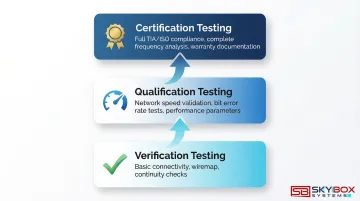
Network cable testing falls into three distinct categories, each serving different purposes:
Verification testing confirms basic connectivity—checking wiremap, continuity, and cable length. It detects opens, shorts, and split pairs but doesn't measure performance against standards. This level suits residential installations and basic troubleshooting.
Qualification testing determines whether cabling can support specific network speeds like 1 Gbps or 10 Gbps. These tools perform bit error rate tests and measure key parameters, but they don't provide the comprehensive frequency-range analysis required for standards compliance.
Certification testing guarantees full compliance with TIA-568 or ISO 11801 standards by measuring strict electrical parameters including NEXT, Return Loss, and Insertion Loss across the complete frequency spectrum. Only certification provides the documentation required for manufacturer warranties.
Why Proper Testing Matters
The structured cabling testing equipment market reached $1.2 billion in 2024 and is projected to grow at 8.7% annually through 2032, driven by increasing bandwidth demands and network complexity.
Proper cable testing delivers three critical benefits:
- Catches installation errors before systems go live, reducing callbacks
- Ensures warranty compliance with manufacturer requirements for 25-year system warranties
- Documents infrastructure records that building owners and network administrators need
Modern Testing Challenges
This market growth reflects evolving infrastructure demands that create new testing challenges.
Network infrastructure demands have increased substantially. Enterprise environments now require 10GBASE-T as standard, while data centers push toward 25 Gbps and 40 Gbps using Category 8 cabling rated for 2000 MHz.
Simultaneously, Power over Ethernet has evolved from 15.4W (802.3af) to 90W (802.3bt Type 4), requiring testers capable of validating power delivery across all four cable pairs.
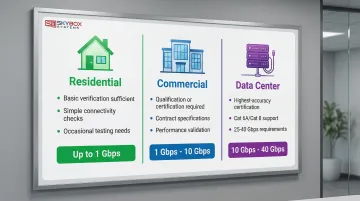
Testing requirements vary by environment:
- Residential installations typically need only basic verification
- Commercial projects demand qualification or certification per contract specifications
- Data center deployments require the highest-accuracy certification to support Cat 6A and Cat 8 installations
Top Network Cable Tester Alternatives
The following five alternatives span budget, mid-range, and professional-grade categories to suit different testing needs and budgets.
Fluke Networks LinkIQ Cable + Network Tester
Fluke Networks dominates the cable testing industry with a reputation built over decades. The LinkIQ, launched in 2020, serves as their accessible mid-range qualification tester that bridges basic verification and full certification.
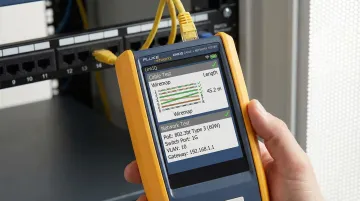
What sets the LinkIQ apart is its combination of cable performance testing up to 10GBASE-T with active network diagnostics. The device identifies the nearest switch and displays its name, IP address, port number, and VLAN information—critical data for troubleshooting connectivity issues.
Advanced PoE testing validates power delivery up to 90W (802.3bt Class 8), ensuring modern high-power devices receive adequate power.
The modern touchscreen interface simplifies operation, while integration with LinkWare PC software enables professional PDF reporting. Time Domain Reflectometry (TDR) provides precise cable length measurement and fault distance location.
| Feature Category | Details |
|---|---|
| Key Features | Tests cable performance up to 10GBASE-T; Displays switch data (name, IP, port, VLAN); PoE testing up to Class 8 (90W); TDR cable length measurement; Wiremap with fault distance location |
| Ideal Use Cases | Commercial network installations; Troubleshooting existing networks; Contractor qualification testing; IT department network maintenance |
| Approximate Price Range | $1,400 - $1,600 USD |
NetAlly LinkRunner G2
NetAlly emerged from NETSCOUT's handheld network tools division in 2019, focusing exclusively on network testing solutions. The LinkRunner G2 represents their advanced network and cable tester, though it's now discontinued with support ending December 31, 2026 (replaced by the LinkRunner AT 4000).
The G2's differentiator is comprehensive network discovery beyond basic cable testing. Built on an Android platform, it provides advanced diagnostics including Wi-Fi analysis, making it valuable for environments requiring both wired and wireless troubleshooting.
TruePower PoE load testing draws actual power up to 90W to validate real-world performance under load—a critical capability that simple voltage detection can't provide.
Cloud-based reporting via Link-Live enables remote configuration and real-time job tracking, significantly reducing reporting overhead for teams managing multiple sites.
| Feature Category | Details |
|---|---|
| Key Features | 10GBASE-T testing; TruePower PoE load testing; Network discovery and mapping; Wi-Fi analysis; Cloud reporting with Link-Live; Nearest switch identification |
| Ideal Use Cases | Network troubleshooting and diagnostics; IT professionals managing complex networks; Environments requiring both cable and Wi-Fi testing; Teams needing cloud-based reporting |
| Approximate Price Range | $2,400 - $2,800 USD |
Noyafa NF-8209 Cable Tester
Noyafa, a Chinese manufacturer, offers budget-friendly alternatives to premium brands. The NF-8209 multi-function cable and network tester delivers essential features at a fraction of premium tester costs.
The value proposition is straightforward: continuity testing, wiremap verification, cable tracing, PoE detection, and fault distance location for $80-$150. While it doesn't perform qualification or certification testing, it covers the basics needed for small business maintenance.
The device supports multiple cable types including RJ45, RJ11, and coax, making it versatile for contractors handling various low-voltage work.
Port flash identification helps technicians locate the correct switch port without manually tracing cables—a time-saver in crowded equipment racks.
| Feature Category | Details |
|---|---|
| Key Features | Cable continuity and wiremap testing; Digital cable tracing; PoE detection; Fault distance location (TDR); Port flash identification; Multi-cable support (RJ45, RJ11, coax) |
| Ideal Use Cases | Budget-conscious contractors; Occasional testing needs; Small business IT support; Residential installations; Entry-level technicians |
| Approximate Price Range | $80 - $150 USD |
Klein Tools Scout Pro 3 Tester Kit
Klein Tools brings over 160 years of contractor tool expertise to the Scout Pro 3, a cable verification and tracing system designed specifically for jobsite durability. The company's reputation among electrical contractors extends naturally to their low-voltage testing tools.
Contractor-specific advantages include:
- Rugged construction with 2-meter drop protection for harsh jobsite environments
- Simple pass/fail testing that eliminates confusion
- Tone generation and tracing to locate cables in walls and ceilings
- Multi-cable support (data, phone, and coax) for versatile installations
The remote kit enables far-end testing without requiring a second technician, and the tool integrates naturally with Klein's broader line of electrical testing equipment.
| Feature Category | Details |
|---|---|
| Key Features | Wiremap testing with remote; Tone generation and tracing; Tests RJ45, RJ11, and coax; Fault distance measurement; Simple pass/fail indication; Rugged contractor-grade construction |
| Ideal Use Cases | Electrical contractors; Low-voltage installers; Residential and light commercial work; Technicians needing combined electrical and data testing tools |
| Approximate Price Range | $120 - $180 USD |
Fluke Networks Versiv DSX-5000 or DSX-8000 CableAnalyzer
The Versiv platform represents Fluke's enterprise-level certification solution and the gold standard for contractors who must provide certified test results per TIA-568 and ISO/IEC standards. This is the tool that enables 25-year manufacturer warranties.
The DSX-8000 certifies cabling up to Category 8/Class FA (2000 MHz), supporting 25 Gbps and 40 Gbps data center applications. The DSX-5000 certifies up to Category 6A/Class EA (500 MHz).
Both platforms use the ProjX management system for automated testing workflows, reducing setup errors and ensuring consistent results across large projects.
Key capabilities include:
- Comprehensive reporting with tamper-proof test results accepted by all major cabling manufacturers
- Modular design allowing fiber testing modules to be added to copper base units
- Industry-leading accuracy that maintains calibration longer
- Annual factory calibration (approximately $700+ per module) recommended for warranty work
| Feature Category | Details |
|---|---|
| Key Features | Full TIA/ISO certification testing; Category 8 support (DSX-8000) or Cat 6A (DSX-5000); ProjX job management; Fiber and copper modules; LinkWare reporting; Industry-leading accuracy |
| Ideal Use Cases | Professional cable installers requiring certification; Data center installations; Enterprise network deployments; Contractors providing warranty-backed installations; Large-scale commercial projects |
| Approximate Price Range | $5,000 - $12,000+ USD depending on configuration |
How We Chose the Best Network Cable Testers
Common Selection Mistakes
Contractors frequently make three critical errors when purchasing cable testers:
Buying more than needed. A residential installer purchasing a $10,000 certification platform for basic continuity checks wastes capital that could fund other business needs. Match your tester to your actual work requirements.
Don't choose by brand alone. While Fluke's reputation is well-earned, their entry-level tools may lack features available in competitors' mid-range offerings. Evaluate specific capabilities, not just logos.
Factor in long-term costs. Budget testers have low upfront costs but may lack calibration services or software updates.
Certification platforms require annual calibration ($700+) and software subscriptions—costs that significantly impact total ownership expenses over five years.
Matching Tester to Job Requirements
The fundamental question is whether your work requires verification, qualification, or certification:
- Verification works for residential installations and basic troubleshooting where you only need to confirm connectivity
- Qualification serves commercial contractors who must prove cables support specific speeds (1G, 10G) but don't need standards compliance documentation
- Certification is mandatory for warranty-backed installations, commercial projects with specification requirements, or Category 6A and above installations
These job requirements directly shape which features matter most when evaluating testers.
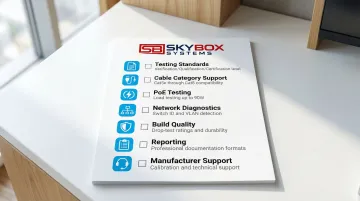
Key Evaluation Factors
When comparing testers, prioritize these factors:
Testing standards supported — Verify the device provides the level of testing your contracts require (verification vs qualification vs certification)
Cable category support — Ensure the tester handles your highest cable category; Cat5e/Cat6 testers can't validate Cat6A or Cat8 installations
PoE testing capabilities — Modern networks increasingly rely on PoE for IP cameras, wireless access points, and IoT devices
Basic voltage detection is insufficient. Look for load testing that validates actual power delivery up to 90W (802.3bt).
Network diagnostic features — Switch identification, VLAN detection, and ping testing significantly reduce troubleshooting time compared to basic cable testers
Build quality and ruggedness — Field reliability matters; look for drop-test ratings and weatherproof designs if you work in harsh environments
Reporting capabilities — Professional installations require documentation; verify the tester produces reports in formats your clients accept
Manufacturer support — Consider calibration availability, technical support, and warranty terms
Conclusion
Choosing the right network cable tester comes down to three factors: your role, testing frequency, and whether you need verification, qualification, or certification capabilities.
Budget testers like the Noyafa NF-8209 ($80-$150) handle basic connectivity verification, while mid-range qualifiers like the Fluke LinkIQ ($1,400-$1,600) work well for commercial contractors who need performance validation without full certification overhead. Enterprise installers requiring TIA/ISO compliance must invest in certification platforms like the Fluke DSX-8000 ($5,000-$12,000+).
Balance upfront costs against long-term value. A $2,000 qualifier you'll use daily delivers better ROI than a $10,000 certifier that's too complex for routine troubleshooting.
Key factors to evaluate:
- Features you'll actually need for your project types
- Manufacturer support quality and response times
- Capability to support future network standards as bandwidth demands grow
Professional installation companies like Skybox Systems rely on certified testing equipment and BICSI and TIA standards-trained technicians to ensure network infrastructure meets industry standards and provides reliable long-term performance. Proper testing reduces callbacks, ensures warranty compliance, and provides the documentation building owners need for their infrastructure records.
For complex network installations in Florida or Georgia requiring professional cable testing and certification, contact Skybox Systems at 1-904-586-4027 (Florida) or 1-470-857-4545 (Georgia). Their team of certified technicians provides comprehensive structured cabling services with full testing and certification capabilities.
Frequently Asked Questions
What is the difference between a cable certifier and a network cable tester?
Cable certifiers perform full compliance testing against TIA/ISO standards and generate certification reports required for warranties. Network cable testers (qualifiers) verify cables can support specific speeds like 1G or 10G but don't provide standards-compliant certification documentation.
How do Cat5, Cat5e, Cat6, Cat6a, Cat7, and Cat8 compare for network cabling?
Each category supports progressively higher performance: Cat5e handles 1 Gbps at 100 MHz, Cat6 supports 1-10 Gbps at 250 MHz, Cat6a delivers 10 Gbps at 500 MHz, and Cat8 enables 25-40 Gbps at 2000 MHz. Higher categories offer better shielding, making them essential for data center environments.
What features should I look for in a network cable tester?
Basic features include wiremap testing, cable length measurement, and pass/fail indicators. Professional users need support for their highest cable category, PoE load testing for networks delivering up to 90W, switch identification, and reporting capabilities for client documentation.
Do I need a cable certifier or will a basic tester work for my projects?
Certification is required when providing warranty-backed installations, working on commercial projects with specification requirements, or installing Category 6A and above where standards compliance must be documented. Basic testers suffice for residential work, troubleshooting existing networks, or installations without certification requirements where you only need to verify connectivity and basic performance.
How much should I expect to spend on a network cable tester?
Budget ranges vary significantly by capability: basic continuity testers cost $50-$200, qualification testers with network diagnostics range from $1,000-$3,000, and certification testers run $5,000-$12,000+ depending on configuration. Your investment should align with whether testing is occasional or a core business function, and whether your contracts require certification documentation.
Can network cable testers test both copper and fiber optic cables?
Most cable testers are designed for either copper or fiber optic testing, as the technologies require different methodologies. However, professional platforms like Fluke's Versiv offer modular designs where you can add fiber testing modules to a copper base unit for comprehensive testing.