Introduction
Selecting the right Power over Ethernet (PoE) cable determines whether your network-powered devices perform reliably or fail unexpectedly. Inadequate cables cause power delivery failures, network downtime, and costly reinstallations that disrupt operations.
The consequences compound quickly: device malfunctions, budget overruns, and infrastructure you can't trust.
Choosing cables with copper-clad aluminum instead of solid copper increases resistance by 55%, causing voltage drops that starve devices of power. Ignoring thermal management in high-power PoE++ deployments creates fire hazards in cable bundles.
For commercial security and access control deployments, Skybox Systems has seen how these cable decisions directly impact long-term reliability and safety compliance across Florida and Georgia installations.
Key Takeaways
- PoE cables deliver both data and power over a single Ethernet cable, eliminating separate power sources
- Cable category (Cat5e, Cat6, Cat6a, Cat8) determines maximum power delivery capacity and future scalability
- Selection depends on PoE standard (IEEE 802.3af/at/bt), cable length, environment, and thermal management
- Professional installation by certified technicians ensures code compliance and optimal performance
What is Power over Ethernet (PoE)?
Power over Ethernet is a technology that allows network cables to carry electrical power alongside data to connected devices. This eliminates the need for separate electrical outlets at each device location.
The result: simplified installations and reduced costs for equipment like IP cameras, wireless access points, VoIP phones, access control systems, and IoT sensors.
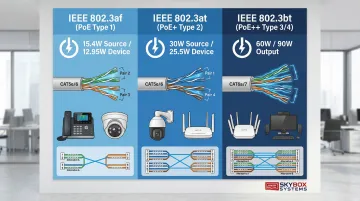
The IEEE defines three main PoE standards that determine power delivery capacity:
- IEEE 802.3af (PoE, Type 1) – Delivers up to 15.4W at the source (12.95W at device) for basic VoIP phones and simple IP cameras
- IEEE 802.3at (PoE+, Type 2) – Provides up to 30W at the source (25.5W at device) for PTZ cameras and Wi-Fi 5 access points
- IEEE 802.3bt (PoE++, Type 3/4) – Delivers 60W (Type 3) or 90W (Type 4) at the source for high-demand devices like Wi-Fi 6 access points, video conferencing systems, and digital signage
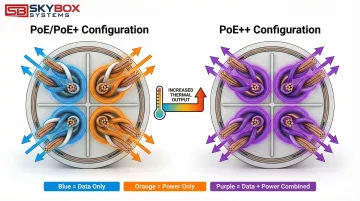
Understanding these standards matters for cable selection because PoE++ (802.3bt) uses all four twisted pairs to deliver power, whereas earlier standards use only two pairs. This distribution reduces current per conductor but increases total heat generation across the cable—a critical factor when choosing cables for bundled installations or high-temperature environments.
Core Components of PoE Cables
Understanding the physical construction of PoE cables helps explain why certain cables perform better than others in power delivery applications.
Conductor Material and Gauge
The conductor material directly impacts power transmission efficiency and heat generation. Two materials dominate commercial installations:
- Solid copper: Required standard for commercial work, offering low resistance (~8.5 ohms per 100 meters for 24 AWG)
- Copper-Clad Aluminum (CCA): Exhibits 55% higher resistance, causing excessive voltage drop and heat that violates NEC standards; non-compliant with TIA standards and lacks valid safety listings
Wire gauge matters for power delivery:
- 23-24 AWG: Standard for horizontal cabling (Cat5e, Cat6, Cat6a); minimizes voltage drop and heat
- 26-28 AWG: Used for patch cords; requires shorter lengths and careful bundle management
Cable Shielding
Shielding determines electromagnetic interference (EMI) protection:
- UTP (Unshielded Twisted Pair): Relies on twisted pair geometry to reject interference—suitable for most office environments
- Shielded cables (F/UTP, S/FTP): Include foil or braid shields that provide EMI protection in industrial settings and help dissipate heat more effectively than UTP in high-power PoE applications
Twisted Pair Configuration
All Ethernet cables contain four twisted pairs of conductors. The twist geometry reduces crosstalk between pairs and supports simultaneous data transmission and power delivery.
Power distribution varies by PoE type:
- PoE and PoE+: Two pairs carry data, two carry power
- PoE++: All four pairs carry both data and power, distributing electrical load evenly but increasing total heat generation
What to Consider When Choosing the Best PoE Cable
Cable selection must align with deployment requirements, power needs, and environmental conditions. The following factors connect technical specifications to real-world performance.
PoE Standard and Power Requirements
Identifying the required PoE standard (af/at/bt) is the first step, as it determines minimum cable category and power delivery capacity.
A Type 4 PoE++ device requiring 71.3W at the endpoint cannot function properly on cables designed only for 15.4W PoE applications—the cable's conductor gauge and thermal properties must support the higher current load without excessive voltage drop or overheating.
Cable Category and Performance Rating
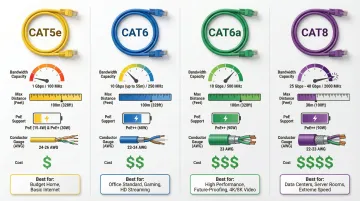
Each cable category defines maximum bandwidth, frequency, and power handling capacity:
- Cat5e: Minimum option for PoE/PoE+ but struggles with PoE++ due to smaller 24 AWG conductors that generate more heat
- Cat6: Recommended standard for most PoE deployments, reliably supporting all PoE standards through PoE++ with better thermal margins than Cat5e
- Cat6a: Superior choice for PoE++ applications, featuring larger 23 AWG conductors with better heat dissipation and supporting 10Gbps speeds over the full 100-meter distance
- Cat8: Premium-grade cabling for data centers with 25/40 Gbps capability, but its 30-meter distance limit makes it impractical for general commercial infrastructure
Maximum Cable Length and Distance
Standard PoE deployments are limited to 100 meters (328 feet) total channel length—typically 90 meters of permanent link plus 10 meters of patch cords.
Beyond this distance, signal attenuation increases and DC loop resistance causes excessive voltage drop, potentially delivering insufficient voltage to powered devices. This limitation affects network topology planning and may require PoE extenders or additional switches for longer runs.
Installation Environment
Distance planning must account for environmental conditions, which determine cable jacket requirements:
- Plenum (CMP): Required for air-handling spaces like drop ceilings—highest fire resistance with low smoke production
- Riser (CMR): For vertical shafts between floors—prevents fire from spreading upward through buildings
- General Purpose (CM): Non-plenum, non-riser areas including patch cords and single-floor runs
- Outdoor (CMX): UV and weather-resistant for exterior installations
Temperature extremes, moisture exposure, and physical stress impact cable lifespan and total cost of ownership.
Shielded vs. Unshielded Cables
Shielded cables become necessary in high-EMI environments (industrial settings, proximity to electrical equipment) where data corruption from interference is likely. UTP is sufficient for most office environments. Shielded cables cost more to install but provide interference resistance and improved heat dissipation in large cable bundles carrying high-power PoE.
Future-Proofing and Scalability
Selecting higher-category cables now supports future PoE standard upgrades and higher-power devices without expensive recabling projects.
A Cat6a installation today supports current PoE+ devices while providing headroom for future PoE++ upgrades and 10Gbps network speeds—a strategic infrastructure investment that extends operational flexibility for years.

Common PoE Cable Categories Compared
Choose the right cable category by comparing key performance specs and use cases below.
| Feature | Cat5e | Cat6 | Cat6a | Cat8 |
|---|---|---|---|---|
| Max Bandwidth | 1 Gbps | 1 Gbps / 10 Gbps* | 10 Gbps | 25/40 Gbps |
| Max Frequency | 100 MHz | 250 MHz | 500 MHz | 2000 MHz |
| Max Distance | 100m | 100m (1G) / 55m (10G) | 100m | 30m |
| PoE Support | PoE, PoE+ | PoE, PoE+, PoE++ | PoE, PoE+, PoE++ | PoE, PoE+, PoE++ |
| Conductor Gauge | 24 AWG | 23-24 AWG | 23 AWG | 22-23 AWG |
| Recommended Use | Budget-conscious, low-power | Most PoE deployments | High-power PoE++, future-proofing | Data centers only |
Cat5e: Budget-Conscious Baseline
Cat5e represents the minimum viable option for PoE and PoE+ applications. Its smaller 24 AWG conductors generate more heat under load, making it unsuitable for PoE++ deployments where all four pairs carry power.
Best suited for budget-conscious installations with lower-power devices like basic VoIP phones and simple IP cameras.
Cat6: Industry Standard for Most Deployments
Cat6 is the recommended standard for most commercial PoE deployments. It reliably supports all PoE standards including PoE++ with better thermal performance than Cat5e.
Key advantages:
- Larger conductor gauge improves heat dissipation and lowers resistance
- Supports 10GBASE-T networking up to 55 meters
- Offers reasonable future-proofing at moderate cost
Cat6a: Premium Performance for High-Power Applications
Cat6a provides superior performance for PoE++ (802.3bt) applications requiring high power delivery. Its 23 AWG conductors offer the best heat dissipation characteristics for high-current applications.
Ideal for:
- Future-proofing high-density installations where devices may upgrade to higher power requirements
- Full 100-meter distance at 10Gbps speeds
- Deployments where longevity and upgrade flexibility justify the additional cost
Cat8: Data Center Specialty
Cat8 represents premium-grade cabling designed for data center environments requiring 25/40 Gbps speeds. While it technically supports PoE, its 30-meter distance limitation makes it impractical for general commercial infrastructure. Cat8 is typically overkill for standard PoE deployments unless ultra-high-speed requirements justify the cost.
How Skybox Systems Can Help
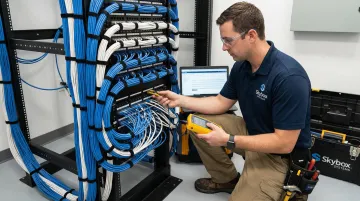
Proper PoE cable selection is only half the equation—professional installation by certified technicians ensures optimal performance, safety compliance, and long-term reliability. Improper terminations, inadequate thermal management, or code violations can undermine even the highest-quality cable.
Professional Installation Expertise
Skybox Systems brings specialized expertise as Panduit Certified Installers with technicians trained to BICSI, NEC, FOA, EIA, and TIA standards. This certification framework ensures installations meet manufacturer specifications and regulatory requirements from project inception through final testing.
Key capabilities that eliminate common coordination challenges:
- Comprehensive structured cabling design and installation: Custom-designed solutions that consider current requirements and organizational growth, from connection points through MDF/telephone rooms to end-user terminations
- Expertise in PoE network infrastructure: Specialized experience with security systems and access control applications that rely on reliable power delivery
- Standards-compliant installations: All work meets NEC/NFPA code requirements, including abandoned cable auditing and removal for safety compliance
- Single-source integration: Eliminates technology silos and coordination headaches by providing unified infrastructure solutions
- Regional coverage: Service across Florida and Georgia with offices in Jacksonville and the Atlanta Metro area, supporting both single-site and multi-site deployments
Skybox Systems works with manufacturers including CommScope, Panduit, Leviton, Chatsworth, Legrand, APC, Eaton, and Vertiv to ensure access to quality components that meet industry standards.
The installation approach emphasizes proper planning, installation according to manufacturer specifications, and thorough testing—the foundation of reliable PoE infrastructure.
Conclusion
Selecting the right PoE cable requires balancing current power needs, environmental factors, and future scalability rather than simply choosing the highest-category option available. Cat6 serves most commercial deployments well, while Cat6a provides superior future-proofing for high-power applications and Cat5e remains viable only for budget-conscious, lower-power installations.
When evaluating options, remember that the goal isn't technical perfection—it's alignment between cable specifications and deployment requirements within budget constraints.
Key decision factors include:
- Power delivery requirements (PoE vs. PoE+ vs. PoE++)
- Installation environment (plenum ratings, outdoor conditions)
- Network distance and bandwidth needs
- Budget constraints and future scalability
A properly specified Cat6 installation often outperforms an improperly installed Cat6a system.
Working with experienced installation teams trained in industry standards (BICSI, NEC, TIA) ensures proper cable selection, compliant installation, network certification testing, and reliable long-term performance. For commercial PoE infrastructure across Florida and Georgia, Skybox Systems delivers standards-compliant structured cabling installations backed by Panduit certification and 15+ years of experience in commercial network infrastructure.
Frequently Asked Questions
Which network cable is best for PoE?
Cat6 is the recommended standard for most commercial PoE installations, supporting all PoE standards (802.3af/at/bt) with solid future-proofing at reasonable cost. Cat6a is ideal for high-power PoE++ deployments and data centers requiring maximum performance.
Is 28 AWG cable OK for PoE?
28 AWG patch cables work for short runs under 10 meters with lower-power PoE devices, but require careful thermal management. For longer runs and higher-power PoE standards, use 23-24 AWG solid copper cables to minimize voltage drop and ensure reliable power delivery.
Is Cat8 overkill for most commercial PoE use?
Yes, Cat8 is overkill for most office PoE applications. Cat6 or Cat6a provides adequate performance for IP cameras, wireless access points, and VoIP phones at significantly lower cost. Cat8's 30-meter distance limitation makes it suitable primarily for data center environments.