What counts as field service?
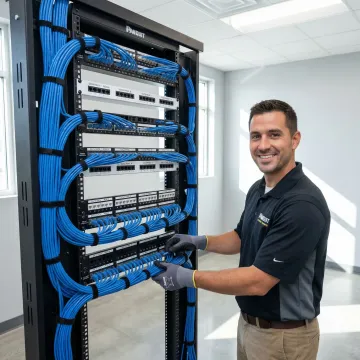
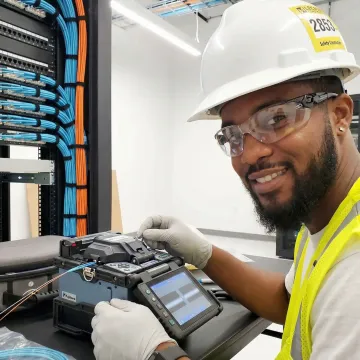
Field service refers to on-site technical work performed at customer locations rather than at a service provider's facility. For network cabling, this includes installing structured cabling systems, terminating fiber optics, mounting network hardware, building telecommunications rooms, and performing certification testing at offices, campuses, data centers, or other enterprise facilities. Our field technicians travel to your location with the equipment and expertise needed to complete installations according to industry standards.
What does a network field technician do?
A network field technician handles the physical installation and maintenance of communication infrastructure at customer sites. This includes running and terminating Cat5e/Cat6/fiber cables, installing patch panels and network racks, mounting switches and routers, performing cable certification testing, troubleshooting connectivity issues, and documenting installations. Our BICSI and Panduit certified technicians follow TIA/EIA and NEC standards to ensure every installation meets professional quality and compliance requirements.
How long does a typical enterprise network cabling installation take?
Project timelines vary based on facility size, scope, and complexity. A small office with 20-30 drops typically takes 2-4 days, while larger deployments spanning multiple floors or buildings may require several weeks. During consultation, we provide detailed project schedules based on your specific requirements, existing infrastructure, and operational constraints to minimize business disruption.
What is the difference between Cat6 and Cat6A cabling?
Cat6 cabling supports speeds up to 10 Gbps for distances up to 55 meters and is suitable for most office environments. Cat6A (augmented) supports 10 Gbps for the full 100-meter distance and offers better shielding against interference, making it ideal for high-density environments, data centers, or future-proofing installations. We recommend the appropriate category based on your current needs and growth projections.
Do you provide warranty and certification documentation for installations?
Yes. All installations include comprehensive certification testing documentation showing performance metrics for every cable run. We provide manufacturer warranties on components from partners like Panduit, CommScope, and Corning, along with workmanship warranties on our installation services. You receive complete as-built documentation, labeling diagrams, and test reports for your records and future maintenance needs.
Can you work around our business hours to minimize disruption?
Absolutely. We schedule installations during evenings, weekends, or off-peak hours to accommodate your operational requirements. Our project managers coordinate closely with your team to ensure minimal impact on daily business activities while maintaining the quality and thoroughness every installation requires.
What brands and components do you typically install?
We install proven, enterprise-grade components from industry leaders including Panduit, CommScope, Corning, Leviton, Chatsworth, Legrand, APC, Eaton, and Vertiv. Our Panduit Certified Installer status and vendor relationships ensure we use quality materials backed by comprehensive manufacturer support and warranties.
Do you handle both new installations and infrastructure upgrades?
Yes. We support new office build-outs, network expansions, technology refresh projects, data center relocations, and infrastructure modernization initiatives. Whether you're starting from scratch or upgrading existing systems, our team assesses your current environment and designs solutions that integrate seamlessly while meeting current standards and future scalability needs.